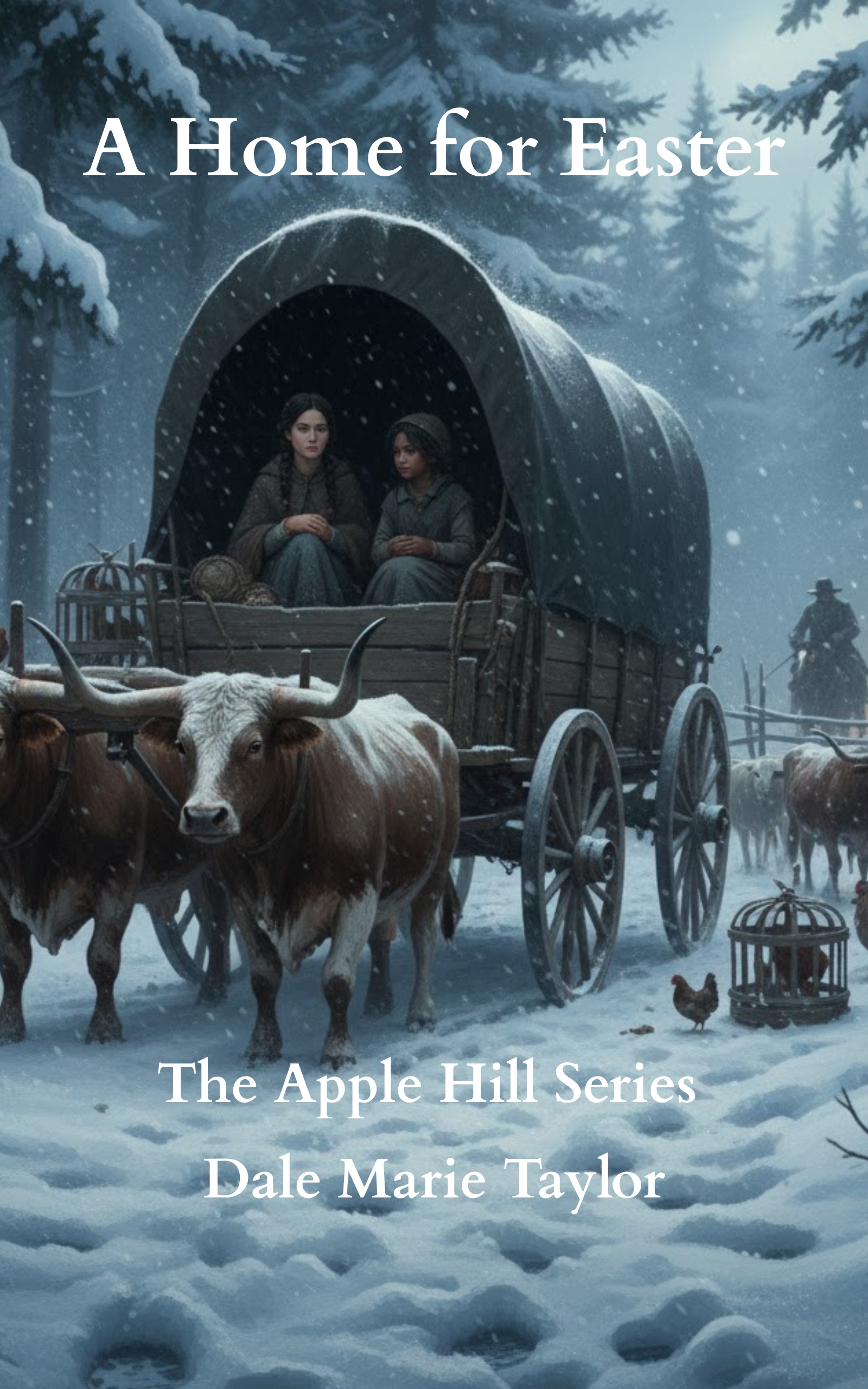
A Home for Easter by Dale Marie Taylor

A Home for Easter Book Trailer
Purchase A Home for Easter here:
GooglePlay Book Store Audio of A Home for Easter
A Home for Easter is a captivating tale set during the tumultuous 1830s removal period for First Nations people. Follow Easter, a resilient Cherokee woman, as she embarks on a journey through middle Tennessee in search of a new home for herself and her unborn child. But her quest is fraught with peril as she finds herself pursued by a ruthless criminal intent on claiming her ancestral lands.
Joined by her steadfast companion, Arter, Easter braves treacherous snowstorms and confronts the dangers of being kidnapped by her relentless pursuer. Meanwhile, her brother, Degataga, makes sacrifices to hold onto their family’s lands, while her sister, Lucinda, forges a new life in the Qualla territory of North Carolina alongside Walking Bird.
Central to Easter’s story is her half-sister, Awinta, whose experiences shed light on the intersectionality of First Nation African Americans within Cherokee society—some enslaved, others integrated into clans. As the narrative unfolds, it offers insight into how diverse groups navigated the challenges of political upheaval, social strife, and economic turmoil, ultimately surviving and even merging during times of adversity.
Exploring the matrilineal structure of Cherokee families and touching on the complex issue of polyandry, A Home for Easter weaves a rich tapestry of resilience, courage, and the enduring strength of familial bonds. Dale Marie Taylor’s vivid prose transports readers to a bygone era, immersing them in a poignant saga of survival and hope against the backdrop of historical injustice.
Read the next book in the Apple Hill Series — Hester’s Journey.
If you have a book club or a group that might like to discuss A Home for Easter, here are some discussion questions you might consider.
A Home for Easter Discussion Questions
- The year is near 1838 when Easter’s story opens. What other historical events predated and occurred at about the same time as this story opens? How do these events affect the lives of the characters?
- Easter manages a small farm as the story opens. What kind of tasks do you imagine she faces? How do those tasks complicate her life?
- Western story telling in the past casts settlers in a binary role with indigenous people. How does A Home for Easter both reinforce that binary and deconstruct the binary? How is the role of settlers represented in the story? What is Easter’s relationship with settlers like? What role does she play in their lives? How does that benefit her and the settlers?
- When Easter prepares to leave her land, she encounters some challenges? What loss does she experience and how does that influence her motivation for leaving? Which of her brothers dies in the story and how does that represent what happens to many indigenous people when both the government and some of the settlers decide First Nations people are interfering with plans to settle the area?
- Who are Easter’s other siblings and what path do they take when they are forced to leave their lands? Degataga marries Ruth, whose parents were missionaries. How does that affect his life? Is he safe from threats? Why or why not?
- What motivates Lucinda to go east with Walking Bird? What is Walking Bird’s group of indigenous people called today and what challenges did they face? How do the Eastern band of the Cherokee come by their land and who is involved?
- Wahali decides to go west on the northernmost trail toward the territory that is set aside for the Cherokee. What challenges do the people on the Trail of Tears face. This story challenges the notion of indigenous people as helpless. How does it do that? While there were certainly large numbers of people who suffered, what does Wahali and his new-found family do to survive?
- Easter is pursued by Ezra who wants her ancestral lands. He is part of the Georgia Guards. What role did the Georgia Guards play in the story? How did they depart from their assigned roles and how did that affect the indigenous people of the territory? What was the motivation of the Guards and some of the settlers. What did they pay for the land they acquired?
- Awinta is the Black Cherokee half-sister of Easter. She accompanies Easter on her quest for a new home. In what way does Awinta represent the innocence of childhood, and could she be construed as a metaphor for the indigenous people and Cherokee?
- A cougar plays an important role in Easter’s survival and ultimate escape. What does the big cat represent in Cherokee culture? How does its final role unfold?
- Arter and John Hester play significant roles in the story. John Hester is Easter’s former husband. How does his relationship to Easter represent the matrilineal structure of Cherokee society?
- Not much is discussed about the ways in which African Americans and indigenous people mixed blood lines. How is this represented in A Home For Easter?
- Arter is a protective presence in Easter’s story. What role does he play? How does he facilitate Easter’s escape and eventual settlement? Why is Arter frustrated with Easter?
- Wahali befriends a medical doctor on the Trail of Tears. How does that change his destiny? How does that relationship affect his interest in healing? Hummingbird and her family become a part of Wahali’s life. How does that affect his motivation for helping her family?
An Excerpt from A Home for Easter
CHAPTER TEN
Awinta snuggled down in the back of the wagon. The horses moved every now and then, shaking off the snow and stomping their feet. That made the wagon shake and shudder. The wind howled, and the snow got deeper. The cows, Sallie and Daisy, complained and tried to pull away from the wagon.
Why did they keep doing that? It was too cold to go off on their own. Maybe they just wanted some water. Maybe they were hungry. Awinta got from under the tarp and looked for the feedbag and feed that Easter kept for the cows.
Awinta made sure each was half full and attached a bag to the head of each cow. She did the same for the horses and mules in hopes that they would settle down. Ama stood beside her as Awinta fed the animals. She wanted the animals to hurry so she could get out of the cold and back into the warmth of the wagon.
She remembered that Arter had watered the animals and let them graze some this morning, but he had not added the special feed that Easter liked to give them.
It seemed to be taking Uncle Arter a long time to get back. Would he find Easter? Would her sister be all right? Would Awinta be able to find the cave if she had to?
She stomped her feet to warm them and clapped her fur-covered hands together.
The wagon shook again as the wind grew stronger. The snow fell in big fat chunks. Awinta stuck out her tongue and tasted the big snowflakes. She laughed as they fell into her mouth and into her eyes. She tried to look up at the sky.
She rubbed the mules’ noses, Keme and Lulu. Lulu snapped at her as was her habit, but Awinta knew to stay away from Lulu’s mouth. She checked Kay and Mico, Easter’s horses, and made certain they were covered. She tried to be certain the mules, Hogan and Tom, were covered too and eating from the feed bags, but Hogan kept shaking off the leather covering and did not care for the food. She exhaled in exasperation and checked the cows again.
Using the step at the back of Easter’s wagon, she got back in. Ama hopped into the wagon with her. Awinta tried to relax, but she could not feel safe. She pulled the map out of her tunic pocket and tried to look at it. It was so dark she could barely see. The horses and mules stamped the ground as though they were impatient to move. She got out of the wagon and removed the feedbags from each of the horses, mules and cows.
She dropped the feedbags back in the wagon and heaved a sigh, looking about her as though Uncle Arter and Easter would appear before her.
She decided it was time. The wind was blowing so hard, and the snow was getting deeper. If she didn’t leave for the cave now, it would be too late. She might not be able to find it. Ama sat up and growled, poking her head out of the leather tarp that covered her, the chickens and goats.
“What is it, Ama?” Awinta said quietly. Ama looked intensely out of the back of the wagon. She looked out herself and saw movement. Was the bad man coming back? Was it a wolf or a wildcat? She couldn’t tell. Maybe that’s why the cattle were so restless. Maybe there was a wildcat in the woods. Ama’s growl became louder. Ama jumped out of the wagon and began to bark and growl loudly as though she were warning something away.
Awinta did not want to fire the long rifle. There was only one shot, and she might need it later. She dug around for Easter’s bow and arrow. Doda had taught her to use it. Easter’s was fashioned for a woman.
Awinta threw off the tarp and aimed the arrow into the woods near where she saw the movement and let the arrow fly. She heard a swift movement after that. Something had run off.
“Come, Ama,” she said to the dog. “We must leave this place.” She tried to look at the map again, but the snow was coming down harder. She would need to leave now to find the cave. She scrambled up onto Easter’s wagon and pushed the lever to unlock the wheels. Then she climbed down from Easter’s wagon and climbed back up to Arter’s wagon. She pulled the lever on that wagon, which was much harder to get free. But finally, the stubborn lever wrenched free and the horses and mules lurched forward. If Arter had not tied the reins to the wagon seat, she would not have been able to guide the animals. They were ready to move.
She struggled to get the thick leather reins from around the metal attached to the seat. She had to take off her mittens to get them undone. Having gotten the thick leather free, she held the reins tightly in her mouth and was almost pulled off the bench when Keme and Lulu lurched forward again.
She dropped the reins out of her mouth and yelped as the leather straps seemed to be snaking away from her. They snapped at her cheek as they escaped. She jumped on them before they could escape completely and pulled with all of her might to get the horse and mules to obey her. She pulled the right strap far to the right and slapped all of the straps as hard as she could, shouting at the team.
“Keme, Lulu, get up,” she shouted. She was surprised when the animals shifted, stomped and stirred. Finally, the wagons began to move toward the road that Arter had said she should take to get to the cave.
The team moved laboriously through the deepening snow. Awinta looked back to see Ama at the back of Easter’s wagon, keeping the cows protected and nipping them every now and then to keep them from pulling at the wagon. The tether that attached Easter’s wagon to Arter’s seemed flimsy, but Awinta could not worry about that. The cows were mooing, upset at the predator they sensed in the woods. The goats complained loudly. She wondered why they didn’t seem to cry so much when Easter was there. Maybe they knew that Awinta didn’t really know where she was going.
Awinta slapped the reins again, and the teams pulled the wagons through the snow on the winding road. It seemed to go on forever. She was having a difficult time seeing where the path was when she looked back to see that the other wagon was left behind. She pulled hard on the reins to stop the lead wagon. She tied the reins to a tree and ran back to the stranded wagon. Its team stamped in the snow and pulled without success. Awinta walked back to see that the front wheels had become mired in a rut.
Why didn’t the wagon she was in stop? She wondered what to do. Seeing the muddy hole the wheels kept sliding in, she looked about for leaves, dry sticks and small rocks. She raced around, getting what she could from the side of the narrow road and from the woods.
She didn’t want to go too deep into the woods to gather material as whatever had been stalking them might be waiting for her. Her heart pounded furiously as she worked to gather debris. Finally, she seemed to have enough dry sticks, dry dirt and leaves to create some traction. She had seen Doda and Easter do this.
She pulled the reins of the horses leading the team. They seemed to hesitate, but after several efforts on her part to urge them ahead and Ama’s barking and nipping at them, the team, led by Hogan and Tom, pulled the wagon over the muddy hole and lurched forward.
Awinta drove the wagon to the lead wagon. Getting down, Awinta tied Easter’s wagon again to the lead wagon, got back on Arter’s wagon and continued down the road. When she got to the end of it, she saw that there was only one way to go — to the left. She pulled the reins to the left and leaned with all her might. The wagon scraped a tree as she turned the team. She thought she might have lost one of Easter’s boxes in the jarring against a tree, but there was no time to get down to find it. She had to get to the cave.
Finally, she saw a large boulder at the end of this road and looked up the hill. There seemed to be an opening ahead. She wondered whether the team could get up the hill with the heavy load. Was it possible? Thinking that she would make the load in Easter’s wagon lighter, she climbed up in Easter’s wagon and lowered the chicken cage to the ground. She carried it up the hill till she got to the entrance of the cave.
She worried that there might be some occupants in the cave so she called Ama. Ama went into the cave and sniffed around. No one seemed to be there, so Awinta hauled the crate into the cave. Next, she brought the goats, and as many small items as she could carry from Easter’s wagon. She rested as the snow got deeper. She realized, as the wind nearly blew her from a rock she’d perched on, that she would need to try to get each wagon up the hills separately.
She untied Easter’s wagon from Arter’s wagon. She led the team with Arter’s wagon ahead a bit and turned it toward the cave. Lulu snapped at her again but seemed eager to move. Awinta wrapped the reins around a large rock.
She walked back to Easter’s wagon and perched on the bench. Like she’d heard the adults shout many times before, she said “Yah! Hogan, Tom,” as loud as she could. But the sound did not seem to carry in the howling wind. She tried again and slapped the reins to the backs of the horses, and they moved up the hill slowly.
The heavy barrels slid to the back of the wagon. The wagon gate seemed to barely keep them in. The hill was not very steep; but it was a hill. As if they sensed that shelter was nearby, the horses and mules pulled the wagon straight into the deep cave. Awinta rested a moment, relieved that she’d been able to get one wagon into the cave. The ceiling of the cave was high and filled with sounds. She shivered, but this was better than the biting wind outside.
Ama barked outside at the other team. The horse and mules neighed and stomped. She scrambled off the bench and left Easter’s team in the cave. The horses and mules stood there obediently. She was amazed.
Awinta ran down the hill to the other team and climbed up on Uncle Arter’s bench seat. She pulled hard to the right, and Lulu and Keme began the laborious climb up the hill. Ama growled at something in the woods, and the team seemed eager to get away from whatever it was.
The horse and mules were so nervous that they scrambled up the hill in a desperate effort to get to the safety of the cave. When Awinta got the other team inside, Ama came in the cave too. She sat guard at the entrance, while Awinta crawled into the back of the wagon, exhausted. After resting a minute, the little girl got up and put the cages and other goods back in Easter’s wagon and herded the goats in too. Then she lay down and slept, covered in furs and blankets and snuggled up to the smelly goats.
Narrativemagic Press, Narrativemagic, LLC (narrativemagic.com)