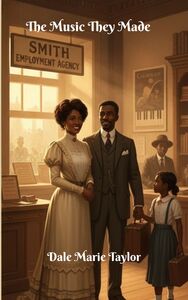

Find The Music They Made at these retail outlets:
The Music They Made GooglePlay Book Store (ebook)
The Music They Made GooglePlay Book Store (audio book)
The Music They Made Print Book at Amazon
The Music They Made Draft2Digital (Books2Read)
[At Books2Read, ebooks are represented at various platforms, such as ibooks, Kobo, Barnes and Noble, etc.]
The Music They Made Summary
Inspired by the true lives of Edward and Carrie Crawford Smith, The Music They Made is a richly woven historical novel of love, loss, and perseverance during one of the most turbulent periods in American history.
Edward leaves Nashville in 1898 to serve during the Spanish-American War beginning in Cuba and disappears into a dangerous world of shifting loyalties, forgotten memories, and far-off conflicts. As Carrie waits, the life they planned slips further from reach — until fate offers them a second chance.
Drawn into the Great Migration, Edward and Carrie journey north to Chicago, where African American families seek safety from Southern violence and Jim Crow oppression. In a growing Black community alive with culture, music, and hope, they build a family, face personal tragedy, and confront the harsh realities of racial injustice, labor struggles, and economic hardship.
Through war, migration, and social change, Carrie becomes a tireless advocate for fair employment and education, while Edward’s violin and Carrie’s piano remain the quiet heartbeat of their home.
The Music They Made is a moving portrait of two imperfect people who, despite separation and sorrow, never fully let go of the bond that first brought them together — and whose legacy is written not only in history, but in the lives they shaped.
The book is available at various ebook outlets and at Amazon as a print book.
Sample from The Music They Made
Prelude
February 1898
The explosion occurred so suddenly that Edward could not feel his body. All sense of time and space left him as he sank to the bottom of the Cuban bay. What had happened before this? The memories came flooding back. Carrie was the love of his life. They had met in Nashville, Tennessee during the Tennessee Centennial Exposition. She and other negroes from Fisk University were playing music there just as he did. They had fallen in love despite her father’s resistance. He was supposed to return to her; they were to be married. But there was a war underway, and he meant to do his part. As the memories faded away, he realized that his life was passing before his eyes. All the things he did, and all the things he meant to do were out of his reach as the darkness enveloped him.
Two days earlier
He found himself walking into the court of an old building where he’d found a room. What passed as the Cuban winter was pleasant.
The building where he lived was one story with a flat roof and plaster on the outside. The buildings in the neighborhood were painted green, yellow or blue. His was a bright green. The music in the old Cuban village near Havana was constant. Regla villagers played drums, guitar, flutes, trumpets, timba – whatever they could get their hands on. Edward marveled that some of the instruments were handmade and some of them were stolen or borrowed from the occupying army.
It was odd, he thought, as the people had little material goods and little in the way of peace. But they seemed united in their suffering and united in their joys. If they ate, they were happy. If they had their loved ones, they were joyous. They played music that was soulful or somber; they were strong. The rebels kept fighting. They pushed back against the Spanish and hoped that the United States would help.
Tensions were high. Riots had begun in January. Edward sent word to Washburn that he would be going into the interior of the country. Damn that Washburn; he had gotten Edward into this mess. He had asked Edward and his brother, Willie, to travel to Cuba to see what they could learn of the dissidents. He had gone several times in the previous months but had not been able to infiltrate any of the rebel groups. Willie had not yet arrived, but Edward had heard that the riots were causing concern in Washington.
Edward recalled his mother, Amanda, and the last moments of his time at Knoxville, Tennessee. She had given him the names of family members who might live in Cuba still and might help him if he were able to find them. One was a cousin or uncle of some sort. Edward’s grandmother and mother were not specific about their connections to the Cubans.
But they were fervent in their desire to see Edward and his brother, Willie, make a connection with family if they could do so. Edward’s grandmother did not speak much about her early life or how she came to be in America. Was it because she was a runaway slave?
Was she brought to the U.S. by a slave-holding family? Or was her family such that they had simply passed through Cuba on their way to Galveston or one of the other slave-auction ports? Those questions pestered him as he pondered his origins.
Edward’s mind returned to the environs of Cuba where he was in between powerful and deadly forces. Both the Spaniards and the insurrectionists were cruel and often randomly marched a villager away on the pretense of his having aided the enemy. He had managed to get work as a servant to one of the wealthy Cuban farmers. He walked to work early in the morning and walked home late in the evening.
There work for those who knew how to negotiate and to ingratiate oneself. He shared his food with the people in the building where he lived. They shared what little they had with him. Though many of the Black Cubans were at first suspicious, they warmed to him as they realized he spoke fluently in their tongue and had learned some of the words of their native Africa as well.
When he got to his room, Edward fingered the letter he’d received from Carrie, his fiancée. He had read it so often that it had begun to tear. He knew that he needed to simply burn it so that no connection to his life back home might be discovered. He promised himself he would read it one more time by the dim light of a candle and then burn it.
He’d managed to find coconuts and had bartered for some greens. That was all there was to eat; later he might be able to get some meat from the farm where he worked. The people there were smart at finding staples. He’d chosen a location near Havana Harbor for its ease in reaching other destinations and for sending messages back home.
Edward had reported that many of the farmers were burning their crops to keep the Spanish army from getting the food.
The room was hot and humid. He walked to the one window and opened the wooden shutters. He’d had to find an old nail to keep the left shutter from falling off.
A cool breeze blew at his back as he walked to the small table and used the pitcher to pour water over his hands so that he could eat. He wiped them on a cloth and dug into the coconut. The old woman who’d given him a plantain had fried it and mashed it up, placing it in an empty coconut shell.
Edward felt fortunate to have it. Many of the locals had very little to eat. But they seemed to find ingenious ways to make use of the bounty of the land. After Edward finished the plantain, he ate a few pieces of coconut and drank some water he’d boiled.
He’d been told that the well water might have been tainted, so everyone was cautioned to boil it. He drank as much as he could stomach before lighting a candle, sitting down in a rickety chair and pulling out Carrie’s letter. The chair creaked as he settled. He’d been given the letter in Florida before leaving for Cuba. Willie had handed it to him. He wondered how his brother was able to get things that other people would not dream of being able to have. Edward had written two letters to Carrie but had received just this one in return. It would be difficult to get mail. He sighed as he read.
Dear Edward,
By now you’re probably serving in the military and
on your way to whatever destination they have planned for you. I was so grateful that you were able to visit with me in Nashville before you took off for parts unknown. Mother seems to think that we will not have a wedding now that you’ve joined the military. I told her that we have our entire lives ahead of us and that we had talked about the importance of serving.
Many of the young men around here, Willella’s young man included, join for the adventure. They want to see the world. They want to fight. They want to be anywhere but at home.
But I know that you are doing this to prove that men of African descent are deserving of full enfranchisement in American society. I shudder to think what will become of you and many other young men who are joining the military. Spain is not afraid of this young country of ours. It thinks we are mere sniveling children compared to its centuries-old history of warfare. But we’ve learned in our classes that even old civilizations can fall.
I hope that ours will continue, even if it is an
experiment in democracy. I pray each day for your safe passage, wherever you may go and whatever you may do. We will have our day, Edward. I believe it with all my heart. Stay well, my love. Think of me tonight when you lay your head down to rest. Know that you are in my heart.
With loving devotion,
Carrie
Edward sighed and smelled the letter. It smelled like Carrie, lavender and bergamot. Carrie had a unique smell. It seemed that lavender and bergamot were part of her. He inhaled as he stared one more time at the letter and then burned it. He could not risk it being found. He checked under the boards of the small room where he placed a small box for valuables. He’d placed coins and currency there. With tensions running high, he could not trust anyone. He would leave it there in case he needed it later.
The next morning, he finished his plantain, which he’d stored in a small wooden box to keep out the rodents. When he had tidied his appearance, he took off for the plantation of Señor Fischer.
The man was nothing if not meticulous. Señor Fischer wanted the sugar cane to be processed secretly and sent to the harbor for shipment to the United States. When Edward finished his chores at the farm, one of the old women, Señora Benita, gave him some jerky and green beans.
He was surprised that she also invited him to her small cabana, which was not far from the farm. It was nothing more than a small cabin with a thatched roof. She pointed to his shoes to indicate he should take them off before entering her home. He placed them inside the door.
The cabana was clean. The floor was packed dirt. There were small handmade rugs on the floor. Someone had painted the little cabin blue. Inside, Señora Benita had a small wooden bench with a back. In a corner, she had a small bed with a carved wooden headboard and a chest of drawers.
Someone cared for this woman. On the bed, she had placed brightly colored cushions in red, green, yellow and blue. Edward guessed the señora had made them herself. The walls were festive with pictures that children had painted for her. Edward pointed to one of a small boy with dog.
“Tu hijo?” he asked.
“Mi nieto,” she said, smiling and taking a deep breath.
“El es muy intellegente y creativo,” he said, smiling. She nodded and smiled. She told him the boy lived with his parents in the mountains. She did not elaborate on whether the child’s parents were rebels. Edward figured she was being cautious with strangers — a wise decision.
Señora Benita showed him to a small table where there were two chairs, also homemade but intricately carved. She stepped to a small cookstove and took a cloth to pour the dish she had made into two ceramic bowls. The aromas of her food reminded Edward of dishes his mother had cooked. He inhaled deeply and smiled warmly at her. She placed a silver spoon at his plate and one at hers, along with a white square of cloth that looked homemade. She smiled shyly and said a brief prayer for their food.
They laughed. She seemed to suspect that his dialect indicated that he was not from Cuba, but she did not call him on it.
“Hijo,” she began in Spanish. “Tienes una novia?” She asked him if he had a girlfriend.
“Si, señora,” he said. “Ella es muy bonita.” Yes, she is very beautiful. Edward grinned and felt the back of his neck grow hot with embarrassment. Señora Benita laughed aloud as she continued to tease him about his interest in women. They continued making small talk and eating.
“Hijo, hay una mujer muy bonita en un pueblo cercano,” she said.
“Gracias, pero mi robaron el corazon,” he said, telling her his heart was taken.
“Sí, sí,” the old lady nodded. “Todo está bien entonces,” she said. All is good.
They ate in companiable silence. Edward complimented Señora Benita on her excellent ajaico. She had used fresh yams, potatoes, corn, chicken, garlic, chilli and other delicious spices. He asked her how she was able to eat so well.
“Tengo mi propio jardin,” she said, telling him she had her own garden. She added that her family had been slaves to the farmer and his wife not long ago. She herself had worked for the family as a servant. They had given her the land on which her little house stood along with some of the comforts she enjoyed. Occasionally, they gave her food. But mostly, she kept her own garden and chickens and bartered for what she could not grow on her own.
Edward nodded. Of course, she would have her own garden, like his mother and like Carrie’s mother and grandmother. Smart women kept their own gardens and never lacked for food. When they finished their meal, he tried to help her with the dishes, but she refused, pointing him to the front of her cabana with a glass of tea. It was sweetened with sugarcane. Edward knew that the U.S. government would stay put to protect the American farmers who were responsible for getting a great deal of sugar to the market.
When Señora Benita joined him on the front porch of her little cabana, he complimented her again on the good meal, and they sat for a while in the cooling day. He asked her whether she needed to get a message to her family in the mountains. She had been the one to give him directions to the various places he had tried to find over the last months. He felt he could trust that she would not reveal where he was going or what he was doing. They had shared much about their lives in the little time he had known her.
She frowned, looked away and then said, “diles que las amo.” Tell them I love them. Edward was to look for a Julio Gomez. She wiped tears from her eyes and asked him to wait a moment while she went to get something for him.
She handed him a St. Christopher medal and a small wooden drum. It was for her grandson. She smiled at him, gave him a kiss on his cheek and told him to go with God. He smiled and told her he would and set off for his next destination, Havana harbor and Castle Morro.
He had been asking around about his family in Cuba; Señora Benita had told him that the members of the Alvarez family were many and that if he found them, they would be in the Guamuha Mountains with the rebels.
Still, he’d paid for someone to get a message to an Alvarez family member to ascertain his familial connection. Everything was done by word of mouth here. Among the Negros, there was no trust as the rebels had been fighting for years with little in the way of results. Many of the rebels held out in the mountains, so getting a message to someone would take time. He thought of his assignments. He’d reported to Washburn three times from different places.
He’d talked with a farmer who was invested in having the Americans intervene against the Spanish government, the rebels and the aristos.
Having received a message from his contact, a quiet unassuming villager, to report to someone on the USS Maine and to wait at Wharf Machina for a rowboat to take him there, Edward made his way to the wharf on foot. It was late in the February day, about 8 p.m., when he arrived. He waited on the wharf, noting that the Maine was a monstrosity of a ship. The ship was at Buoy No. 3, and a light had been flicked on to indicate that he was to find a boat that was being sent for him.
Edward frowned as he noticed some activity near the ship. Edward had always been good at seeing in the dark. He stared at some figures that seemed to be rowing quickly away from the ship. But he lost sight of them.
Sometimes, a contact would come later than stipulated, so he found a hidden spot and waited. As he hid in the shadows of Castle Morro, a seaman knocked on the wharf boards to signal his location.
Edward quickly climbed down a ladder and settled into the dingy. The seaman pointed to the oars, and both men put their backs into getting to the Maine as quickly as possible.
Just as they drew near the ship, an enormous explosion rocked the dingy, throwing Edward and the seaman into the water. Edward felt his head hit something hard as the explosions continued. He tried to fight his loss of sense, but there was no hope for it. He felt his body sinking to the bottom of the harbor — helpless to stop himself or help those he knew had also been struck by this awful blast.
The Music They Made and other books by Dale Marie Taylor are published by Narrativemagic Press. (narrativemagic.com)